_edited_edited.png)
Your application for grid reinforcement was rejected. Now what?
- May 19
- 3 min read

Your business wants to grow, go greener, or launch a new project, but the grid operator won't play ball and your request for a stronger connection gets turned down. The world is electrifying fast, but the grid often simply can't keep up.
Waiting lists are growing, and your business can't sit around until 2030. So what do you do when grid reinforcement isn't on the table? Here are the two most common situations and the solutions available to you right now.
A construction site with a limited connection
You're about to kick off a building project, but the local connection is only 3x80A or even 3x40A. That's nowhere near enough to run tower cranes, hoists, or pumps.
Stopping isn't an option, so diesel it is?
Waiting for the grid to be upgraded can take months, sometimes years. No developer or contractor can realistically put a site on hold just because there isn't enough power.
The classic fallback is a heavy diesel generator. It works, but it costs you. Fuel bills are high, and keeping the tank topped up means constant logistics. On top of that, you take a hit on sustainability and reputation: the noise and emissions are causing friction more and more often. In many city centres, restrictions on running hours are already in place, and in some cases diesel generators are banned outright.
A battery as a smarter temporary fix
A mobile battery container is a quieter, more responsive, and cleaner alternative. Thanks to its microgrid functionality, the battery charges continuously and gradually through your existing small grid connection. When your site needs a burst of power - for a crane, a hoist, or a pump - the battery delivers it instantly.
You can rent a unit for a single project or buy one and move it from site to site. They're plug-and-play: straightforward to set up and operational within the hour.

Is a battery always enough?
A battery can deliver serious power, but that doesn't make it a universal answer. On very large sites with a lot of heavy machinery or exceptionally high simultaneous demand, a single unit may fall short. In that case, you can combine multiple units, or we work out together which mix of sources (grid, battery, and possibly a small generator) makes the most sense for your setup. Honest, tailored advice matters more here than a one-size-fits-all solution.


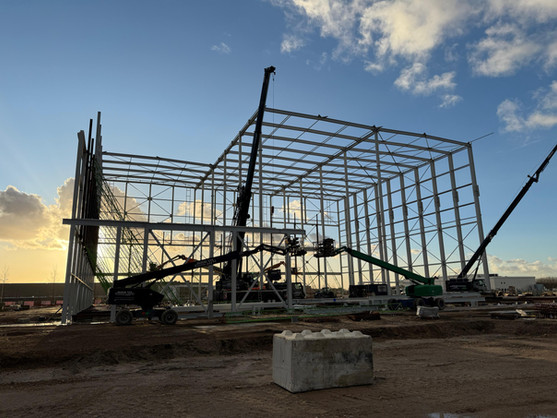
See how this works in practice, find out how we kept the Cordeel site in the Netherlands on schedule despite a limited grid connection. Read case here.
A permanent business location without enough capacity
You want to install charging points for your fleet, or expand production, but a rejected grid reinforcement request puts everything on hold. Waiting on a new application or scaling back your ambitions isn't an option if you want to stay competitive.
Peak shaving: getting more out of the same connection
Instead of laying a heavier cable, you can install a local energy buffer. A battery system absorbs the peaks in your consumption (what's known as peak shaving) so you can still power your charging infrastructure or heavy machinery without pushing past the limits of your current connection.

The result: you're up and running straight away, independent of the grid operator's schedule, and you often get more out of your own solar generation too.

How do you add charging points to a car park when the grid can't handle it? We helped Interparking make their charging ambitions a reality. Read case here.
Grid congestion: from problem to opportunity
A battery solution can be more than a stopgap. Some businesses use it as a bridge until the grid operator can deliver the upgrade. Others deliberately opt for a permanent local buffer because it gives them more control and flexibility in the long run than relying on the grid.
A battery can also open up new revenue streams. Grid operators like Fluvius offer what are known as flexibility contracts. You make your battery available to the grid during periods of high demand. In return, you receive a fee or improve your position in the connection waiting list.
Did you know… investments in local energy storage can qualify for various support schemes? Both through local and European funds, there are subsidies and tax benefits available. More information here: VLAIO (BE), RVO (NL), Horizon Europe (EU). |
Don't let your project stall because of a "no"
A rejection from the grid operator doesn't have to be the end of the road. With the right energy buffer, you can make your site future-proof today - no need to wait for a heavier connection.
Want to know what's possible for your situation?
We're happy to think it through with you.
.png)